School Information Report
What types of SEND (Special Educational Needs and/or Disabilities) do we provide for?
Beech Hill Community Primary is a mainstream Primary School with an attached specialist resource base. In the mainstream school we provide for all types of SEND where we have been selected as the most appropriate setting for the child. The individual needs of each child is at the heart of what we do.
Our Admissions policy details the criteria for applying for a place at Beech Hill Community Primary.It is firstly the decision of the parents/carers to choose which would be the most appropriate setting for their child.
The Local Authority will consult with school when allocating places for the specialist resource base. Places will be allocated to pupils who live within the local community and who have an EHCP with communication and interaction needs which are a result of their diagnosis of autism. These pupils will be working at a similar stage of development to the pupils who are already accessing the specialist resource base at any given time.
The mainstream school provides for:
Communication and interaction
Cognition and learning
Social, emotional and mental health difficulties
Sensory and/or physical needs
How do we identify and assess pupils with SEND?
Identification of SEND can come from a range of people and places.
Parents may make us aware of these before their child starts school, or at any time during their education.
Any staff who work with children may be the ones to first observe SEND in the school setting, or the information that we gather about your child’s learning and/or progress may show that s/he may be struggling with an area of learning.
Class teachers will always discuss any concerns with parents/carers first to keep them fully informed. They would also have a discussion with the School Inclusion Lead (Mrs A Saddington)
The steps that follow this would entirely depend on the needs of the individual. The following are some of the possible routes we could take:
- Classroom staff would use the Ordinarily Available Inclusive Practice document to adapt provision where needed.
- Inclusion Lead can advise class teachers on adapting planning and provision for the child.
- Additional intervention/pastoral support may be put in place to support need where appropriate and an initial concern action plan could be written and reviewed after a term to help to show progress towards targets.
- If staff/families still have concerns about the amount of progress made, a Learning Support Plan could be written if children are needing continued support or more support.
- After a discussion with parents/carers a child may be referred to an external agency for assessment to support staff in further identifying need or to help with strategies to support.
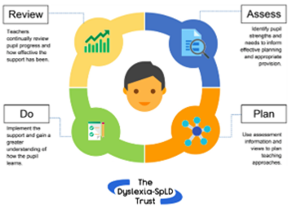
- School will follow a cycle of assess, plan, do, review when setting targets and planning support for children (see below)
- External Agencies include, but are not limited to:
- Educational Psychologist
- Speech and Language Therapist
- Target Educational Support Service (TESS)
- Occupational Therapy/Physio
Who is our Inclusion Lead and how can she be contacted?
Mrs Saddington is the Inclusion Lead. Mrs Hobin is our Early Years SENDCo
In the first instance, class teachers are the first contact for any concerns you may have as they know your child well. Should you require any advice, reviews or further meetings, teachers can arrange this with Mrs Saddington (or Mrs Hobin if your child is in Nursery or Reception class).
What is our approach to teaching pupils with SEND?
As a school, we pride ourselves on quality first & adaptive teaching. This means that we observe areas of learning that children may struggle with and adapt the provision in the classroom to reduce challenges.
We follow the Graduated Approach to support children with additional needs which involves a process of identification of potential need which is followed by: ASSESSMENT of children's strengths and areas for development (including discussion with external specialists where necessary), PLAN- what strategies/adaptations will be beneficial DO- implement the strategies. Most of the time this will be through ordinarily available practice. Children who need significantly more adaptations may also have an LSP detailing specific targets and how these will be achieved.
REVIEW- We regularly monitor and review the effectiveness of support provided. The plan will be formally reviewed and discussed with parents/carers and a new plan written at least each term.
Where children have been assessed by an external agency, we implement the most appropriate recommendations and monitor these. This always works on a cycle of Assess, Plan, Do, Review.
e.g. Recommendations are planned and implemented. After a term, if the impact is positive, these strategies continue.
OR
Recommendations are planned and implemented. If, after a term, there is no impact, these strategies are reviewed and changed for the cycle to begin again.
Sometimes a child may be referred to a different external professional.School will support the child by implementing strategies to adapt the curriculum and interventions that are suggested.
How do we adapt the curriculum and learning environment?
Any adaptions made are always as a response to the needs of individual children. There are endless possibilities.
The following examples are ways in which the curriculum and learning environment can be adapted:
- Adapting physical resources, e.g. larger print, coloured overlays.
- Room layout
- Seating plans changed
- Use of different colour pens on the main board.
- Visual timetables
- Use of timers or visual cues
- Adapting the layout or quantity of work
- Physical resources to aid learning, e.g. blocks, Numicon, writing frames etc.
- Sensory resources
- Workstations
- Behaviour reward charts
- Intervention groups
- Pastoral Intervention groups eg Lego Club, Therapeutic stories
- Lunchtime groups
How do we enable pupils with SEND to engage in activities with other pupils who do not have SEND?
Social and emotional development is equally as important as academic learning. At Beech Hill we offer extra areas of support for children who are struggling with their peers. This may include specific pastoral sessions on friendships and social skills.
The school curriculum offers all children education on respect, tolerance, empathy, and kindness. For more information, please see our PSHE Policy.
In the classroom the children are mixed ability and groupings are often swapped and changed depending on the task they need to complete. Our children work in teams, in small groups, in pairs and independently. Where possible, children with SEND will work with children they feel comfortable with.
Pupils who have physical disabilities are supported to engage in all aspects of the curriculum and to work with all children.
School will seek support from OT/Physio and the outreach team as appropriate to make sure that pupils with physical disabilities and medical needs are able to access the full curriculum, with the requisite adaptions.
All children are included in all subjects, clubs and visits.
How do we consult parents of pupils with SEND and involve them in their child’s education?
Parents/carers are fundamental to the education of their child. WE believe that it is essential to providing the best support for our pupils. You will be involved in the provision for your child from the very start. Children starting in school in EYFS will all be offered an individual meeting about their child prior to the autumn term.Staff will also offer you a home visit. If your child attends another setting, they will visit children in their setting and speak with key staff there to gather as much information as possible to make the transition to Beech Hill as smooth as possible.
Our ‘initial concern’ documents help us to gather information from you about your child and set targets and together we discuss the challenges that they may be facing. If together, we feel that your child’s needs may be longer term then, after their initial concern cycle has been completed and reviewed, they will go on to have an LSP which will tell you about the targets for your child. These are discussed and reviewed with families each term. Regular reports from class teachers will detail how they are performing in each subject.
Parental permission is necessary for submitting most referral forms and these agencies will also ask for your input.
A small number of children will need a higher level of support despite having had an LSP and more support from external agencies. At this point we will speak with you about applying for an EHCP. Parents are part of the process for requesting a needs assessment and if the SEND team feel a plan is appropriate, writing the plan.Parents are invited to contribute at the planning stage and are asked for their views on the plan when it is at the draft stage. Parents are then invited to annual review meetings to decide if the current plan remains appropriate.
In addition, it is important to remember that class teachers are often available at the end of each day and are happy to discuss your child or any concerns you may have.
How do we consult pupils with SEND and involve them in their education?
All children are consulted on the education they receive. We often understand how children learn best by asking them in a way that is appropriate for their age and ability. Our SEND pupils have a learning passport. The passport shares with adults who work with them, amongst other things- what works well and what to say and also what doesn’t work well and what not to say.
When a child has SEND they are consulted about the provision in place for them. They understand their targets and how these will be achieved. As part of their LSP review, children understand that the strategies need to work for them and they will help to shape these by letting us know what is working and equally what is not.
The voice of the child is completed when external agencies are involved. This helps the child to communicate their needs. Children always understand why they are being assessed, but we feel it is important that no pressure is put on the children, as a result this is delivered in an appropriate way for the individual.
How do we assess and review pupils’ progress towards their outcomes?
Each term, LSP targets are reviewed with each child, parents and any staff working with the child. These will be written with the agreement of all involved. Staff will use a range of methods to assess pupil attainment and progress including, where appropriate, formal assessments and small steps trackers.
Mrs McCarthy and Mrs Saddington will review assessment information with class teachers at the end of each term to check all children are making good progress in all areas of learning. If there are any concerns with progress, we will work with the class teacher to adapt provision where necessary. Progress and evaluation are reported to the governor with responsibility for SEND.
How do we support pupils moving between different phases of education?
We have good transition processes in place for pupils of all ages both moving into school into Nursery and Reception and onto Secondary School in Year 6. We also work well with previous and receiving schools if children change schools in between these times.
Parents and children starting school are invited to attend INSPIRE sessions offered to all families. This allows them to come into the classroom and meet their peers and the staff who will be working with them. We offer individual meetings to all families at home to discuss their child and find out about their development. The class teacher attends transition meetings for any children who haven’t attended our Nursery to learn more about each child and will visit the children in their nursery setting. The Beech Hill Nursery and Reception classes work as a unit throughout the year and at transition time there is detailed handover. Any children with SEND that are known to the Local Authority are discussed at a further transition meeting with the class teacher.
Within school we have transition days at the end of each academic year. The children visit their new classroom and begin some lessons with their new teacher. Children who need extra support with this process are given transition booklets detailing the changes that will happen.
This contains photos for the child to look at with parents at home. It can also be arranged for the children to complete extra visits to their new classroom if necessary. Class teachers take part in detailed handover sessions including attending the summer term pupil progress meetings with Mrs McCarthy and Mrs Saddington so that they contribute to the conversation about support needed going forward, including interventions to support learning and pastoral development and adaptations in the classroom.
Year 6 children who are transitioning to high school are part of visits to the high school they will be attending. A teacher from the High school will have a meeting with our Year 6 teachers to find out key information, including friendship groups etc. If extra visits would be helpful, then we will organise them with the High School.
How do we support pupils with SEND to improve their emotional and social development?
In addition to the individualised support detailed above, children are also supported in their emotional and social development by:
- An anti bullying policy informing all practice.
- A Pastoral team that provides group support and individualised programmes of support such as: ELSA, Talking Mats, TIS, play therapy, programmes such as anger management, self-esteem building, and social skill development
- Targeted support for individual pupils
- A range of leadership roles including School Council, Eco council, Inclusion Champions, Mental Health Ambassadors, Peer buddies, Science Ambassadors etc
- Pupil Voice (including the annual PASS survey)
- Termly- Motional Assessments
What expertise and training do our staff have to support pupils with SEND?
We provide training for our staff continually to meet the current and changing needs of the children and to further develop their skillsets.
In school we have:
- A qualified SENDCO
- A Pastoral Team with experience, training and qualifications in TIS, Social skills, pastoral, trauma, bereavement etc.
- Nine Trauma Informed practitioners with level 5 diploma qualifications
- Highly experienced teaching staff, including teaching assistants who support and facilitate learning.
- Specialist support gained from external agencies.
Some of the CPD includes, but is not limited to:
Mental health lead training
-
- Mental Health Awareness (all staff)
- First Aid
- Team Teach Positive Handling
- Adaptive teaching
- Soundswrite
- Wellcomm
- Specific support for pupils with specific difficulties eg dyslexia/dyspraxia and dysgraphia
- Autism awareness, Specific language development programmes
Assessments to inform LSPs for example, dyslexia screener, digit span test, Phab2, YARC, Renfrew, Irlens assessment, Cambridge and SNAP questionnaires
How will we secure specialist expertise?
If further training is needed, as a school we will seek the most appropriate provider to deliver this to relevant staff members.
How will we secure equipment and facilities to support pupils with SEND?
The school has an allocated budget per pupil that is spent on the education of all pupils. This covers staff and resources. Should any further equipment and resources be needed to meet a specific SEND this can be covered by school.
When the amount spent on a single pupil exceeds £6,000 it may be possible to apply for further funds from the Local Authority (LA). Usually this takes the form of an EHC Plan.
How do we involve other organisations in meeting the needs of pupils with SEN and supporting their families?
External organisations are involved when a referral is made for a child. This usually happens following a meeting with parents, assessment of the child and feedback to school. Sometimes, the same professionals may return to gather further information/consult with staff, or to be part of review meetings where appropriate. This mostly happens with EHC Plans.
Sometimes a family can be supported for a wide range of reasons by external agencies. On occasions like this we may be able to open an Early Help. In the Early Help meeting we discuss what is working well and what needs to be done next to support the child and his/her family.
Support can be offered or a child/family referred to the most appropriate agency to meet their needs. Any professional involved is then invited to attend the Early Help review meeting after 6 weeks to determine next steps.
At Beech Hill Community Primary, we take the safeguarding of our children very seriously. We have a duty of care to all our children and must report to Social Care anything that could be seen to put a child at risk of harm. We are totally committed to supporting parents and families. Any help, advice or extra provision we can provide will always be offered. We then collaborate with families and Social Workers to support the child and family.
Where children are CLA (children looked after) and have SEND, school will work closely with the Virtual School staff to make sure that these children get the support that they need at the right time to help them to make progress. Sometimes, a member of the staff from the Virtual School may visit school to support a CLA child that is having a challenge in a particular area.
How do we evaluate the effectiveness of our SEND provision?
We review the progress of interventions and adaptations on a termly basis with Mrs McCarthy and Mrs Saddington. Class teachers will review progress frequently and adaptations to provision will be made accordingly. This includes reviewing additional support recommended by external professionals. Whole school monitoring of SEND provision is completed by the Senior Leadership Team. Progress and evaluation is reported to the Governor with responsibility for SEND. An SEN Information Report is posted on our school website.
How do we handle complaints from parents of children with SEND about provision made at the school?
We would always encourage you to come and talk to us about anything you are unhappy about, it is always best for children if we can work with families to resolve any issues. Mrs Saddington is always available on the playground at the beginning of the school day. If you need a longer conversation, please phone the office to make an appointment to discuss.
Beech Hill Community Primary School's Complaints policy is available on request and can also be downloaded on the school's website.
You can also contact SENDIASS, a charity who work with Wigan SEND Team. They will be able to provide someone to attend school with you to discuss the progress of your child. They can be contacted on 01942 233323.
Who can young people and parents contact if they have concerns?
If you have concerns about your child, you should talk to your child’s class teacher first. You may wish to ask for a meeting with the Inclusion Lead (Mrs Saddington).
Following this you will need to talk to the Headteacher (Mrs McCarthy). Please contact the school office on 01942 243582.
In the unlikely event that we cannot resolve the issues you can contact the SEND team at Wigan Council or SENDIASS.
What support services are available to parents?
Wigan Council SEND Information, Advice and Support Service can be contacted on:
01942 486131 or 01942 364441, Monday to Friday 9am – 5pm.
Where can the LA’s local offer be found?
Full details can be found at
You can also click on the link located on our SEND webpage.